
 English
 Français
 Español
 Deutsch
 Italiano
 Português PT
Simulateur d'autonomie
Quelle batterie LIFE pour votre matériel ?
Ajoutez vos appareils (un seul ou un combo), indiquez votre durée de sortie, et on vous recommande le modèle adapté.
Estimation indicative basée sur les consommations constructeur. Pour un dimensionnement précis ou un cas particulier, contactez-nous.
How to choose the right lithium battery for fishing
Choosing a fishing battery isn't about the brand of your motor: it's about energy. It all comes down to three numbers — the voltage (V) required by your motor, the capacity (Ah) and the total energy (Wh) — and how long your outings last. The simulator above does the math for you; here's the logic in plain terms so you can choose with confidence.
The rule to remember: Energy (Wh) = Capacity (Ah) × Voltage (V). A LIFE 12.6V 105 Ah battery therefore stores ≈ 1 134 Wh. To work out your run time: divide the battery's energy by the power your gear draws (in watts).
1. Start with your motor's voltage
Voltage is never a choice: it's dictated by your electric motor. A battery must match that voltage exactly. At LIFE, each voltage corresponds to a specific cell configuration (3S, 4S, 6S, 7S, 9S, 10S):
- 12 V (3S configuration, 12.6 V fully charged) — float tubes and small dinghy motors (Rhino, Watersnake, small Haswing models, Minn Kota Endura…).
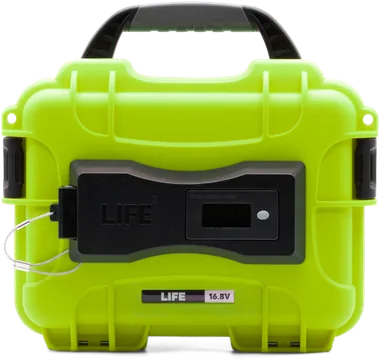
- 16.8 V (4S) — dedicated to electronics (fish finder, live sonar): these units accept 10 to 32 V and become more efficient above 12.8 V. Not to be used on a 12 V motor.
- 24 V (6S, 25.2 V) and 24 V (7S, 29.4 V) — dinghy and boat motors from around 55 lbs upward (Minn Kota, Haswing…).
- 36 V (9S, 37.8 V) and 42 V (10S) — large bow-mount motors and boats (Minn Kota Terrova / Ulterra 112 lbs, bass boats).
LIFE covers this entire range: 12 V, 16.8 V, 24 V, 36 V and 42 V, from 55 to 155 Ah. Fitting a 12 V battery to a 24 V motor won't work: always start by checking this voltage.
2. Then the capacity (Ah), based on your devices and outing length
Capacity in amp-hours determines run time. Here are the typical average draws we've measured, which also feed our simulator:
| Equipment | Average draw | Impact on run time |
|---|---|---|
| Standard fish finder (Garmin, Humminbird, Lowrance) | ≈ 10 to 20 W | Low — a few Ah are enough |
| Live sonar (LiveScope, ActiveTarget, MEGA Live) | ≈ 25 to 40 W | Moderate — screen + module draw a lot |
| Float tube motor (~30-45 lbs) | ≈ 200 to 300 W at peak | High — the main draw |
| Dinghy motor (~55 lbs, 12/24 V) | ≈ 500 to 700 W at peak | Very high |
| Boat motor (24/36 V, 80-112 lbs) | ≈ 1 300 to 1 800 W at peak | Maximum — aim for 105 Ah+ |
In practice, a motor is rarely run flat out: on a relaxed fishing trip it draws only a fraction of its max power. That's why the simulator asks for your usage intensity and your outing length.
3. Which LIFE battery for your craft?
| Use case | Typical gear | Recommended LIFE battery |
|---|---|---|
| Float tube | 12 V motor + fish finder | 12.6 V 55 Ah (lightweight) — 16.8 V 55 Ah with LiveScope |
| Dinghy | 12/24 V motor + fish finder/live sonar | 12.6 V 105 Ah or 25.2 V 55–105 Ah |
| Boat | 24/36 V motor + electronics | 25.2 V 105 Ah or 37.8 V 105–155 Ah |
For a specific setup (LiveScope + bow-mount motor + console fish finder on the same battery), launch the simulator: it adds up the real draws and recommends the right model.
Why lithium rather than lead-acid or AGM?
At the same rated capacity, a lithium battery vastly outperforms a lead-acid/AGM on the points that matter when fishing:
- Genuinely usable energy: lithium discharges to ~100 % without damage, versus ~50 % for lead-acid. A 55 Ah lithium battery therefore replaces a ~110 Ah lead-acid for equivalent use.
- Weight: two to three times lighter — decisive on a float tube and for carrying the battery to your spot.
- Stable voltage: no sonar screen dimming at the end of the trip; the live image stays sharp.
- Fast charging and long life: full in 1 to 3 h and hundreds more cycles than an AGM.
What LIFE does differently
LIFE designs and assembles its batteries in France, using premium 21700 lithium-ion cells. Every battery is factory-calibrated: there's nothing for you to set up, it arrives ready to fish. Our 16.8 V packs take advantage of the fact that live sonar modules (LiveScope, ActiveTarget) accept an input up to 32 V and become more efficient above 12.8 V — letting you squeeze more run time out of the same capacity. The entire range is managed by a BMS and built for demanding marine use.
Unsure about your setup? Contact us and we'll size your battery with you.
Frequently asked questions
Which lithium battery should I choose for a float tube?
For a float tube fitted with a 12 V electric motor and a fish finder, a 12.6 V 55 Ah lithium battery covers a full day's fishing while staying light to carry. If you add a live sonar such as LiveScope, go for a 16.8 V 55 Ah model for more run time and a stable image.
Which battery for a LiveScope or live sonar?
A live sonar (Garmin LiveScope, Lowrance ActiveTarget, Humminbird MEGA Live) draws roughly 25 to 40 W, screen included. A 55 Ah lithium battery powers it for a full day. These modules accept an input of 10 to 32 V: a 16.8 V pack improves efficiency over a 12 V one at equal capacity.
How do I calculate my battery's run time?
Run time (h) = Battery energy (Wh) ÷ Power drawn (W). Example: a LIFE 12.6 V 105 Ah stores ≈ 1 134 Wh; against a 15 W fish finder it lasts dozens of hours; against a motor pulling 300 W on average, about 3 to 4 h under sustained use. The simulator at the top of the page does this calculation based on your gear.
What's the difference between Ah and Wh?
Ah (amp-hours) measure capacity, but mean nothing without the voltage. Wh (watt-hours) measure the real energy stored: Wh = Ah × V. To compare two batteries of different voltages, compare the Wh, not the Ah.
Does a 55 Ah lithium battery replace a 110 Ah lead-acid?
Yes, in practice. A lead-acid battery only delivers ~50 % of its capacity without harm, whereas lithium delivers ~100 %. A 55 Ah lithium therefore provides as much usable energy as a 110 Ah lead-acid, at two to three times less weight.
Which voltage for my motor: 12 V, 24 V or 36 V?
Voltage is dictated by the motor, never chosen. Float tubes and small dinghy motors run on 12 V; motors from around 55 lbs upward are often 24 V; large bow-mount motors (Minn Kota Terrova/Ulterra 112 lbs) and bass boats run on 36 V. Check your motor's spec sheet before ordering.
Can I power my motor and my fish finder from the same battery?
Yes, as long as they share the same voltage and the capacity covers both draws. The simulator adds up motor + fish finder + live sonar and recommends the right model with a safety margin.
Are LIFE batteries made in France?
Yes. LIFE (Lithium Innovation French Engineering) designs and assembles its 21700 lithium-ion batteries in France. Every battery is factory-calibrated and delivered ready to use: no setup is needed on the angler's side.